
Daily Reflections for Nature Connection
There are some lovely moments in the Gospels in which Jesus, sitting or walking with his disciples, calls their attention to something. There is a sense that the disciples inhabit two worlds but are perhaps aware only of one until he says to them “Do you see this?” and, looking more closely, something deeper is revealed. Approaching nature in our own time we too find that we occupy two worlds, those of science and spirituality, and most of us are more familiar with the first. This book is an attempt to bring these two worlds into closer companionship.
Coming from the Christ tradition, having studied Environmental Science and Theology, I do not believe there is a conflict between them, even if in the past they have seemed like “two countries separated by a common language”. For many centuries Christians have broadly accepted the belief that nature may be seen as a kind of book that, like the Bible, contains revelation. Indeed Scripture itself seems to point this way. The God we believe in does not belong to some other realm but has very firmly chosen this one. So it made sense to me to begin by setting these two perspectives alongside each other, like companions walking in the woods, in the knowledge that they are bound to speak and, in you, find out where that conversation leads.
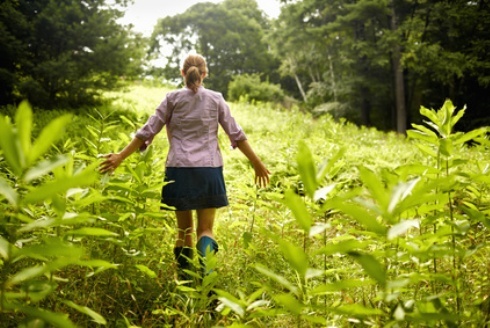
Watching our steps
As with any exploration or pilgrimage, we need to look where we are going. Humans are great storytellers, and the experiences of many generations and cultures has furnished us with stories featuring those creatures with whom we share the natural world. In recent generations a new awareness has begun to emerge as we ask “who is telling this story and to whom?” And of course we find that humans are telling the stories to other humans. In fact our fellow creatures are quite alien to us. We cannot become Dr Doolittles and learn their languages. So I want to be wary of the tendency to observe a particular characteristic in, say, an animal and draw too obvious a parallel with human behaviours. I want to avoid common myths about certain creatures (for example “the solitary badger”) that have no basis in fact, to recognise the ‘otherness’ of our fellow creatures, and let them teach us. So I have done my best here, but there is a long way to go. Bruce Stanley, author of Forest Church, once commented that he would not feel confident to make big statements about all trees, and is not sure how long he would need to stay with just one solitary Birch before he could confidently claim to know it. This diffidence is a valuable counterpoint to the brazen confidence with which humans have tramped into the woods in the past. We need to learn to tread lightly, but the good news is that we do have a place. We do not need to carve it out. Nature is hospitable to all.
Contents
The full contents of the book I hope to publish is listed below. Those marked * will remain available online until 10th May, but if you are a publisher and would like to see more sample chapters and an overview of how I see it working as a book, please get in touch.
Introduction (this page)*
Acknowledgements
1. Ash*
2. Red Ant*
3. Badger
4. Raven
5. St George’s Mushroom
6. Rook*
7. Brown Trout
8. Magpie
9. Peregrine*
10. Frog
11. Water Vole
12. Blackbird
13. Roe Deer
14. Shrew
15. High Brown Fritillary
16. Leopard Slug*
17. Honey Bee
18. Pipstrelle
19. Ivy
20. Wild Boar
21. Red Squirrel
22. Toad
23. Stoat
24. Rosebay Willowherb
25. Mistletoe
26. Trees*
27. Hawthorn
28. Grey Seal*
29. Hedgehog
30. Jay
31. Mole
32. Earthworm*
33. Mayfly
34. Kingfisher
35. Orb Weaver
36. Fox
37. Adder
38. Chicken of the Woods*
39. Meteorite
40. Oak
41. Eel
42. Hermit Crab
43. Maundy Thursday
44. Good Friday
45. Holy Saturday
46. Easter Sunday*
Conclusions
Indexes
Structure
Each short chapter begins with a reflection on a specific creature. I am not seeking to be comprehensive but rather thought-provoking, so if something piques your interest, trust that instinct and research further. My suggestion is that you read slowly, asking for the grace of awareness, and see whether any particular word or phrase stands out for you. Build some time of silence into your daily routine and if something does stand out stay with it, asking for deeper insight. In most, but not quite all, of the chapters I include some steps we can take to aid the creature mentioned, based on the belief that there is plenty of room in this country for everyone. “Love your neighbour”, and even “love your enemy” applies here, just as it does towards other humans. The prayer section is a suggestion not a prescription, and the same is true for any exercises. These things are offered to help you but if the Spirit leads you in another way then trust that instinct. There is plenty of time to come back to any of this if you wish. The key is to do what is right for you, and to be kind to yourself; to allow yourself to be loved and to see how that love transforms you.
Names
It is strange what stays with you over the years. One of the most vivid memories from my first degree (Environmental Science at the University of Plymouth) was a brief conversation on a field trip in the first year. Another student simply commented that she thought common English names for different species were often more poetic and descriptive than the Latin ones so beloved of scientists. The use of Latin names is the realm of taxonomy, a discipline that seeks to categorize and create hierarchies as well as establish relationships. Whilst this may be useful for research, I agree that it can lack ‘soul’ and so I have chosen to use common names. If this is an irritant to tidier minds than mine I apologise, but I would also point out that life is not tidy, and that human attempts to impose order upon it can be unnecessarily energy-intensive and even damaging. It’s Springtime: let a thousand flowers bloom!
He, she or it?
There is an ongoing debate about introducing new, genderless, pronouns into the English language, something that would resolve a big difficulty I had in writing this. The problem is that, whilst some creatures divide neatly into female and male, others do not. Some are hermaphrodite (containing both sexes), others are effectively genderless. I want to show respect to my subjects, all of which are living creatures, not objects, so in each chapter I have chosen to use the words “he” and “she” and never “it”. This does not mean that I am excluding the other sex, but rather suggesting we focus in on an imagined individual. Since the suggested alternatives (zhe, ze, xe, co, e) are not yet in common use, I have decided not to use them. I just think it would distract from the text. So whilst I am aware that saying “he” of a Hawthorn tree, which always carries both sexes in “his” flowers, is inadequate and even a bit misleading, I have decided to press ahead and I ask you to bear with me. You will see that, for the sake of balance, I use male and female in different chapters but within each chapter I have maintained consistency, again to avoid confusion. Otherwise you would see sentences like “He benefits greatly from direct sunlight when her fruit is able to ripen”. I feel this is clumsy, distracting and confusing.
The praise of the creatures
It has been said that, unlike humans, other species in the world offer praise to their creator not through specific acts of worship but merely by being themselves (see Psalms 19, 104 and 148). My own sense as I listen prayerfully is that any attempt to differentiate humanity from ‘the rest’ of nature causes more problems than it solves. We are intimately linked with other species, from the microbes that inhabit our bodies to the macro scale. We have no life independently of other life. Yes, it may be accepted that modern science, which emerged from the eighteenth century onwards, has discovered many things that have benefitted us, not least because of its tendency to dissect and categorize. But in these days we have become more aware of the damage this does too, and a new appreciation of our interdependence is being sought. We are part of a larger phenomenon that is life, and the discovery is a joyful one. Perhaps our own ongoing reflection and prayer can reveal to us just how fully our own being expresses praise. My hope is that these reflections will enable you to be more fully yourself and thereby to give greater praise to your creator.
There are, of course, a number of creatures with which we are familiar, or at least think we are: Fox, Badger, Owl, Deer all make an appearance – predictably enough, you might think. But I have attempted to incorporate some species that would not necessarily make the ‘A’ list. I have done this because I really want to call these preferences into question, to heighten awareness of how and why we turn away from some things and towards others, and to encourage you to value, and enter into a deeper relationship with, creatures you may not have previously considered. So the journey, I hope, will not be an entirely comfortable one as unhelpful scripts are rewritten. It may not be a road completely untravelled before - I am relying heavily on the discoveries of others – but I hope it will, for many, be a new road, one not previously taken.
My hope is to eventually publish “Daily Reflections for Nature Connection” as a book later this year. I am really keen to know how it is received so please add your comments in the space below.
With every blessing,
Dan Papworth,
February 2015
Please bookmark this post at Facebook or Twitter:


Your comments:
Hi Sue,
Thanks for your interest. Yes the book is due to be published early in 2016. I do not have an exact date yet but will post here and through my Twitter account @MindfulWanderer
Every blessing,
Dan
#2. By Dan Papworth on October 28, 2015
Hi Again,
The book is due to be published on 24th June 2016. If you want to get updates and brief extracts you can find the book on Facebook and Twitter. Links below:
https://www.facebook.com/TheLivesAroundUs/?fref=ts
https://twitter.com/LivesAroundUs
Thanks again for your interest.
#3. By Dan Papworth on February 14, 2016

Essex Forest Church
We seek to find the presence of God in the open air and in nature, and to connect with the Divine Being who is present in creation. We seek to foster a love of creation, a love which will lead us to care for it. We look for reconciliation between nature and human beings, and within human relationships. More ...

Daily Reflections for Nature Connection
There are some lovely moments in the Gospels in which Jesus, sitting or walking with his disciples, calls their attention to something. There is a sense that the disciples inhabit two worlds but are perhaps aware only of one until he says to them “Do you see this?” and, looking more closely, something deeper is revealed. Approaching nature in our own time we too find that we occupy two worlds, those of science and spirituality, and most of us are more familiar with the first. This book is an attempt to bring these two worlds into closer companionship. More ...
StNicHardwicke:
Come join us today at #forestchurch all ages welcome including dogs... pic.twitter.com/QSJBIy1UY4
19 Mar
GreenChristian_:
Forest Church (and Mossy Church) bit.ly/1Xo9Kjt #messychurch
14 Mar
unicorntreebks:
If anyone is interested in the idea of forest Church then please do join the group (and/or share it with others... fb.me/S8nfZvXE
16 Mar
Hi Dan, I would love to buy your book - did you publish yet? It puts in mind of Jamie Samms Medicine Cards and Philip Carr Gomm Animal Oracle. The 2nd overarching theme in the Bible is Creation I’m guessing because it was through and for Jesus and held together in Him. Job 12:7 recognises that all creation knows the work of God…
Very best wishes
#1. By Sue on October 27, 2015